2023 and beyond- The wild ride that is recruitment
Default Author • January 23, 2024
2023 was an odd year in recruitment. AI finally stormed in, akin to a hangry bull in a China shop. Terrifying and enthralling in equal measures. You know it will probably kill you but, lordo, it’s fun to watch.
The excitement continued throughout the year as Irish recruiters and their HR/Talent Management counterparts cautiously embraced AI, using Chat GPT to craft original, meaningful job descriptions – a refreshing change from the usual copy-paste from Indeed. These descriptions were so good, they could’ve made Google’s EVP blush.
Those with toes firmly dipped began to look at their marketing team with AI artificially raised eyebrows created through ‘Magic Design’ and began to create their own copy and creative candidate campaigns.
By June 2023 over 43% of all recent Marketing Graduates had registered as full time plumbers – this in turn led to a 47% growth in new electric Ford Transits. Note; This last sentence may have been made up.
Using AI rich parsing tools like ‘Parseur’ gathered pace and war weary talent teams could finally get through the 73,435 CV’s and LinkedIn profiles sent randomly by ‘cold calling’ Shotgun Stevie agency recruiter. Similar ‘word search tools’ have been around for a long time and growth is expected to reach epic speeds in 2024.
As for AI-led interviews? The idea of a deepfake AI Tadhg Furlong or Michael D Higgins conducting screenings sounds fun, and the technical capability is now with us – but thankfully as yet remains untried. Mind you, we’re watching this space from behind our Ray-Ban® Meta sunglasses with anticipation and amusement.
AI has also spiced up those cold recruitment emails, making them slightly more bearable. You know the ones…. ‘Hi Ryan. Thank you for visiting our platform – clearly as a leader in your field you know a good product when you see it….’
Has now become…
‘Hi Ryan old buddy. We know your classmates used to call you Willis at primary school so let’s go with that… so Willis after you had your Special K with a dash of blackcurrant jam this morning would you have ten minutes to chat with your new best friend over here?’
Beware, the AI spammers are getting smarter.
I guess at this stage you want some actual real data: LinkedIn’s recently released research shows 9.9% of Irish professionals switched jobs last year, outpacing the UK’s 9.3%.
The job market in Ireland remains a candidate driven market. Interestingly just 25,523 of those 200,748 moves in Ireland related to an external job posting reflecting the low level of ‘active candidates’ with the majority of moves coming from passive candidate hires (and hard search spade work) and internal promotions.
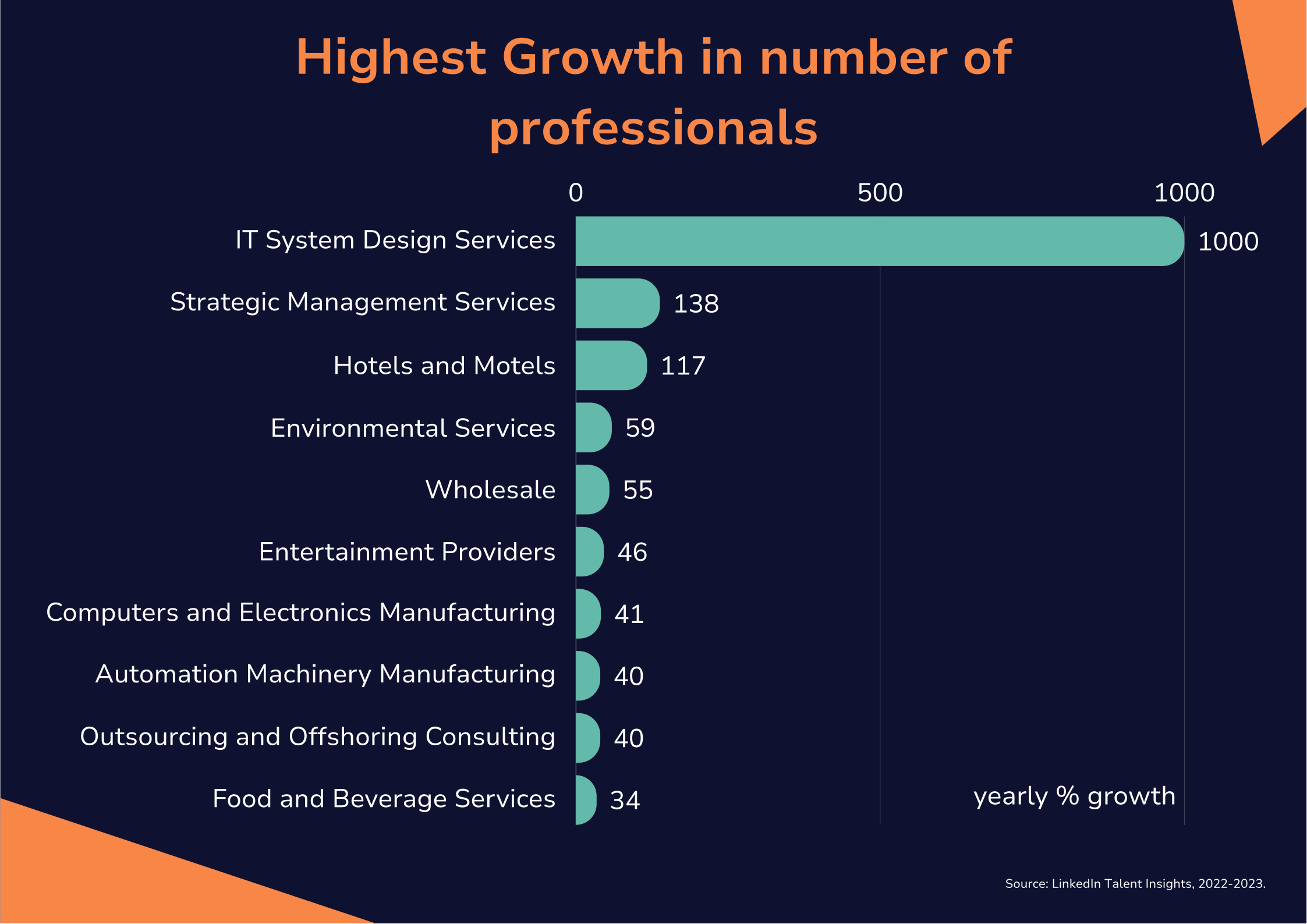
In 2023, Ireland’s tech market witnessed a staggering 1000% growth in the number of professionals – that’s not a typo, it’s tech gone wild! Amidst the global tech shake-up, with heavyweights like Twitter, Netflix, Amazon, and Meta trimming their sails, Ireland stood surprisingly steady.

The excitement continued throughout the year as Irish recruiters and their HR/Talent Management counterparts cautiously embraced AI, using Chat GPT to craft original, meaningful job descriptions – a refreshing change from the usual copy-paste from Indeed. These descriptions were so good, they could’ve made Google’s EVP blush.
Those with toes firmly dipped began to look at their marketing team with AI artificially raised eyebrows created through ‘Magic Design’ and began to create their own copy and creative candidate campaigns.
By June 2023 over 43% of all recent Marketing Graduates had registered as full time plumbers – this in turn led to a 47% growth in new electric Ford Transits. Note; This last sentence may have been made up.
Using AI rich parsing tools like ‘Parseur’ gathered pace and war weary talent teams could finally get through the 73,435 CV’s and LinkedIn profiles sent randomly by ‘cold calling’ Shotgun Stevie agency recruiter. Similar ‘word search tools’ have been around for a long time and growth is expected to reach epic speeds in 2024.
As for AI-led interviews? The idea of a deepfake AI Tadhg Furlong or Michael D Higgins conducting screenings sounds fun, and the technical capability is now with us – but thankfully as yet remains untried. Mind you, we’re watching this space from behind our Ray-Ban® Meta sunglasses with anticipation and amusement.
AI has also spiced up those cold recruitment emails, making them slightly more bearable. You know the ones…. ‘Hi Ryan. Thank you for visiting our platform – clearly as a leader in your field you know a good product when you see it….’
Has now become…
‘Hi Ryan old buddy. We know your classmates used to call you Willis at primary school so let’s go with that… so Willis after you had your Special K with a dash of blackcurrant jam this morning would you have ten minutes to chat with your new best friend over here?’
Beware, the AI spammers are getting smarter.
I guess at this stage you want some actual real data: LinkedIn’s recently released research shows 9.9% of Irish professionals switched jobs last year, outpacing the UK’s 9.3%.
The job market in Ireland remains a candidate driven market. Interestingly just 25,523 of those 200,748 moves in Ireland related to an external job posting reflecting the low level of ‘active candidates’ with the majority of moves coming from passive candidate hires (and hard search spade work) and internal promotions.
In 2023, Ireland’s tech market witnessed a staggering 1000% growth in the number of professionals – that’s not a typo, it’s tech gone wild! Amidst the global tech shake-up, with heavyweights like Twitter, Netflix, Amazon, and Meta trimming their sails, Ireland stood surprisingly steady.
The country’s bustling, high-growth local tech scene elegantly stepped in, absorbing any talent overflow. This resilience highlights Ireland’s tech sector not just as a player, but as a charismatic, fast-paced innovator in its own right.
The recruitment world is seeing a seismic shift from the old-school, no win no fee agency models to more bespoke in-house and RPO solutions. This change is picking up speed, with the Davids of the recruitment world – the smaller, nimbler agencies – steadily outpacing the Goliaths in market share. It’s becoming clear that in the recruitment arena, bigger isn’t always better. Niche RPO providers and specialist recruiters are emerging as the real champions, focusing on building relationships rather than just transactions. They’re like the Katniss Everdeens of the recruitment Hunger Games – agile, strategic, and playing the long game, aiming their arrows straight at the heart of quality over quantity.
So there you have it, recruitment anti-trends of 2023 packaged up. Let’s dance into 2024 with confidence and our best TikTok filters ready.
July 9, 2026
Ireland’s National Development Plan (NDP) 2021-2030 represents the most ambitious infrastructure investment in the history of the state, with a committed capital spend of €165 billion. While the financial capital is secured, the success of the NDP hinges entirely on human capital. For Ireland to deliver on its climate, housing, and connectivity targets, the workforce must scale at an unprecedented rate. At Consica, we monitor these talent shifts to ensure our partners are positioned to attract the niche engineering and project leadership required to turn these blueprints into reality.
July 9, 2026
The global insurance industry is no longer "moving" toward digital transformation; it has arrived. Traditionally seen as the steady, process-heavy giant of the financial world, the sector is currently undergoing its most aggressive structural realignment in history. At the heart of this shift is InsurTech — a high-velocity ecosystem of start-ups and incumbents redefining how risk is priced, sold, and managed. For leadership and talent teams across Ireland and Europe, the message is clear: the battle for competitive advantage has moved from product portfolios to people pipelines. At Conscia, we are seeing a fundamental change in how InsurTech organisations approach growth. Scaling in this environment requires more than just "hiring"; it requires a strategic workforce model that can bridge the gap between traditional insurance expertise and high-end digital engineering.
The Great Retention Challenge: Navigating the Mechanical Engineering Talent Market in Ireland and NI
By Ellen Ross
•
July 9, 2026
Current market data paints a vivid picture of the Mechanical Engineering sector across Ireland and Northern Ireland: a landscape defined by rapid growth, extreme hiring demand, and a workforce that is increasingly on the move. With 16,280 professionals now active in the region—a 10% year-on-year increase —the talent pool is expanding. However, for employers, the headlines are dominated by the difficulty of securing and retaining these individuals.
By Ellen Ross
•
July 9, 2026
In a competitive hiring landscape, there is a hard truth that many organisations are slow to accept: the talent you need is likely not looking for you. When a position opens, the first instinct is often to "go to market" by posting on job boards or LinkedIn. While this attracts 'active' candidates—those immediately available or unhappy in their current roles—it completely bypasses the passive talent pool . Estimated to make up roughly 70% of the global workforce, passive candidates are individuals who are currently employed, successful, and not actively browsing job listings. They are the high-performers, the innovators, and the leaders. And because they aren't looking, they aren't applying. To reach them, organisations must shift from reactive posting to proactive Executive Search and Strategic Talent Mapping . The Barrier: Why Job Boards Fail the Top 5% The best candidates rarely apply for jobs because they don't have to. They are being looked after by their current employers, or they are too busy delivering results to spend time on job portals. Furthermore, high-level talent often views "applying" as a risk to their current confidentiality or a commoditised process that doesn't respect their experience. To move them, you don't need a job description; you need a conversation .
July 9, 2026
In the modern talent market, your employer brand isn't what you say in your "About Us" section or the glossy photos on your Careers page. Your employer brand is the lived experience of every person who interacts with your organization during the hiring process. For many candidates, the recruitment journey is their first and most impactful point of contact. At Consica , we view the recruitment process not just as a series of administrative steps, but as a critical marketing and retention tool. When we partner with clients, we ensure that every touchpoint—from the first touch to the first day—reinforces a culture of professionalism and respect.
July 9, 2026
In the current economic landscape across the UK and Ireland, "vacancy" is often viewed as a line item on a budget—a temporary saving in payroll costs. However, this is a dangerous misconception. The true cost of a vacant role extends far beyond the saved salary, manifesting as a corrosive force that affects productivity, morale, and long-term strategic growth. For organisations in the Irish and British markets, where talent competition remains fierce despite broader economic fluctuations, understanding the "Cost of Vacancy" (CoV) is essential for effective workforce planning.
July 9, 2026
In today's Irish labour market, public sector organisations are no longer competing solely with one another for talent. Local authorities are competing with technology companies for digital specialists, semi-state organisations are vying with international engineering firms for technical expertise, and regulators are looking to attract experienced legal professionals in an increasingly competitive market. For decades, the public sector relied on the promise of job security, a strong pension, and structured career progression to attract candidates. While these remain valuable benefits, they are no longer enough on their own. Today's workforce is looking for organisations that offer purpose, flexibility, development opportunities, and a positive employee experience. Candidates want to understand not only what a role involves, but why it matters and what it's like to work there. At Conscia, we see these challenges every day. As an embedded Recruitment Process Outsourcing (RPO) partner to public sector organisations across Ireland, we support clients in attracting specialist talent across engineering, technology, regulation, healthcare, finance, legal, leadership and professional services. One thing is clear: organisations that invest in their employer brand consistently attract stronger candidates, build more sustainable talent pipelines, and improve long-term retention. Employer branding is no longer just a recruitment initiative—it is a strategic investment in an organisation's future workforce.
By Joanne Curran
•
July 9, 2026
As of mid-2026, the regulatory landscape for Artificial Intelligence has shifted from theoretical discussion to mandatory compliance. For employers and Recruitment Process Outsourcing (RPO) providers in Ireland and across the EU, the EU AI Act is now the primary framework governing how technology interacts with talent. In the recruitment sector, AI tools are almost universally classified as 'High-Risk' . This designation brings significant responsibilities. Below, we explore how to navigate these changes while maintaining a competitive edge in talent acquisition.
July 9, 2026
The 7 June 2026 deadline for EU Member States to transpose the Pay Transparency Directive (2023/970) into national law has passed, and Ireland has officially joined the list of nations currently playing catch-up. While the Irish government has missed the transposition deadline, for employers and RPO partners, this is a "period of grace" rather than a signal to stop preparing. The Department of Enterprise, Trade and Employment is now moving toward a phased implementation. For Irish business leaders, understanding this adjusted timeline is essential for strategic workforce planning.